

June, 2026
The Future of the PM Role: From Coordination to Orchestration

- Aimen Babur
The Future of the PM Role: From Coordination to Orchestration
I once saw a project manager spend nearly forty-five minutes of a one-hour meeting reading Jira tickets to a room full of engineers. It wasn’t a failure of effort. It was a sign of the era we’ve been operating in. For years, many organizations have treated PMs as coordination engines who are collecting updates, aligning stakeholders, polishing decks, and keeping the machine moving. That work matters, but it is also repetitive. And anything repetitive becomes a candidate for automation.
This is why AI feels unsettling for project managers. If a tool can summarize meetings, draft the status update, flag risks, and chase follow-ups, what exactly is left for the human? The uncomfortable answer is that the most visible part of project management was never the real value. It was the most time-consuming part. The real value has always been transparency, accountability & outcomes. AI isn’t eliminating the PM role. It’s pressuring it to evolve.
Most delivery environments are fragmented. One update sits in Jira, another is buried in Slack, a key decision happened in a call that nobody documented, and the true timeline exists only in a lead developer’s head. PMs have historically acted as the connective tissue, stitching together these fragments into a coherent narrative. AI can do a lot of that stitching faster than a human can. It can extract action items from transcripts, detect patterns, and generate drafts instantly.
However, AI comes with a catch. It amplifies whatever system it is operating inside. If your inputs are inconsistent, your definitions are unclear, and ownership is vague, the output won’t become clarity. It will become confident noise.
A perfectly formatted plan is still a weak plan if requirements are unclear or priorities are unstable. This is where the shift happens. We move from coordination, which is moving information around, to orchestration, which is designing the system, so the right decisions happen at the right time.
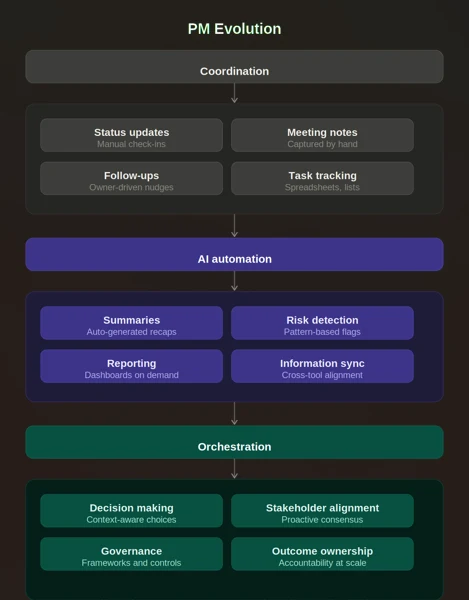
In the coordination era, being organized could carry you far. In the AI era, being organized is the baseline. The differentiator is your ability to create a decision system. Projects rarely fail because a task was forgotten. They fail because trade-offs were avoided, decisions were delayed, and priorities kept shifting without consequences. Stakeholders often want speed, certainty, and low cost at the same time. An orchestrator doesn’t pretend those tensions don’t exist. They face them early, force clarity, and convert ambiguity into commitments.
AI also introduces a new temptation, outsourcing thinking. When a model proposes a timeline or suggests an approach, it can feel like the system is in control. But accountability doesn’t transfer to software. When a project hits a wall, stakeholders don’t ask what the model suggested. They ask who approved the direction and why. The orchestrator PM owns the logic behind decisions, not just the documentation that records them.
If there is one implication PMs should take seriously, it is that future-proofing is no longer about becoming better at administration. It is about becoming better at judgment. The PMs who thrive over the next decade will be the ones who can frame trade-offs, drive difficult decisions, and connect delivery outcomes to business objectives. AI can generate a plan, but it cannot fully understand organizational context, competing incentives, or the consequences of getting a decision wrong.
The most valuable investment a project manager can make today is not learning how to create better status reports. It is developing stronger business acumen, decision-making ability, stakeholder influence, and systems thinking. The future belongs to PMs who use AI to eliminate administrative overhead while doubling down on the human capabilities that technology struggles to replicate.
This is where the human advantage becomes clearer. AI can summarize conflict, but it cannot resolve it. It can detect disagreement in a thread, but it cannot fully understand the dynamics underneath it. It is only a project manager who knows competing incentives, trust issues, fear of escalation, and the politics of resourcing. Orchestration depends on sensemaking. It is the ability to interpret what the projected signals mean and communicate the truth in a way that creates alignment. Not just that something is late, but what it impacts next, and what decision is required to protect the outcome.
If AI is taking over coordination work, then project managers must intentionally invest in the skills that are hardest to automate.
First, become exceptional at decision-making. Teams rarely struggle because they lack information. They struggle because they cannot convert information into timely decisions. PMs who can frame trade-offs, evaluate risk, and drive clarity will remain indispensable.
Second, strengthen business and domain knowledge. AI can generate plans, but it cannot fully understand your organization’s strategy, customer priorities, commercial realities, or political landscape. The more context you possess, the more valuable your judgment becomes.
Third, learn to design systems instead of managing activities. Rather than asking, “How do I track every task?” start asking, “How do I create an environment where the right decisions happen automatically?” Governance, accountability structures, and decision frameworks will become increasingly important.
Fourth, embrace AI as a partner rather than viewing it as a competitor. PMs who understand how to use AI effectively will outperform those who avoid it. The goal is not to compete with automation but to use it to eliminate administrative overhead and create more space for strategic thinking.
Finally, invest heavily in influence and communication. As automation increases, leadership becomes more human, not less. Aligning stakeholders, resolving conflict, building trust, and creating commitment are capabilities that technology can support but not replace.
Many organizations will treat AI as a shortcut. They will automate reporting while leaving priorities vague. They will generate plans while ownership remains unclear. They will move faster without improving governance. Those efforts don’t just fail. They fail faster. The future PM is the person who introduces speed responsibly, not by slowing teams down, but by putting guardrails in place so autonomy doesn’t turn into chaos.
The real question isn’t whether AI will replace project managers. The question is whether project managers will remain stuck in a coordination identity while the work shifts toward orchestration. Coordination keeps work moving. Orchestration keeps work meaningful. One is operational while the other is leadership, and AI is accelerating the transition.

Aimen Babur
Aimen Babur works as a Project Manager at TenX